 ultimate-guide
How to Choose the Best Greek Olive Oil in 2026
Table of Contents
- What "Best" Actually Means on a Greek Olive Oil Label
- The Extra Virgin Olive Oil Health Benefits That Justify the Price
- Reading the Label: Harvest Date, PDO, and Koroneiki
- How to Store Olive Oil Properly Once You Get It Home
- The Best Olive Oil for Cooking vs Finishing
- How to Spot a Counterfeit Bottle at Home
- Price-to-Quality: What You're Actually Paying For
- Frequently Asked Questions
Last Updated: September 24, 2026
What "Best" Actually Means on a Greek Olive Oil Label
Choosing the best Greek olive oil starts with knowing that "best" on a label is marketing, not a grade. The terms that carry legal weight are "extra virgin," the harvest date, and a protected designation of origin seal. This guide walks through the signals that actually predict quality.
- Grade: extra virgin, verified on the label
- Harvest date: the single most reliable freshness signal
- Origin: a specific region or estate, not just "packed in"
- Variety: Koroneiki and other named cultivars
- Packaging: dark glass or tin, never clear plastic
The Extra Virgin Olive Oil Health Benefits That Justify the Price
The extra virgin olive oil health benefits come from polyphenols, the natural antioxidants that give good oil its peppery bite. These compounds degrade over time and with heat, which is why fresh, cold extracted oil costs more than refined oil stripped of them.
What the research consistently points to:
- Polyphenols act as antioxidants and are linked to heart health. The main classes in olive oil are hydroxytyrosol and oleuropein derivatives, and they are the same compounds responsible for the bitter, peppery sensation.
- Monounsaturated fats, primarily oleic acid, support healthy cholesterol levels when they replace saturated fat in the diet.
- Vitamin E (alpha-tocopherol) is preserved in minimally processed oil and acts as a fat-soluble antioxidant.
- Anti-inflammatory compounds are highest in early harvest oil, when the olives are still green and the polyphenol concentration peaks.
How to Judge Polyphenol Content Without a Lab
Most bottles do not print a polyphenol number, and the ones that do are self-reported. Estimate quality with three at-home signals:
- The cough test. A fresh, high-polyphenol extra virgin oil triggers a distinct catch in the throat a few seconds after you swallow. That reaction is the oleocanthal, a polyphenol compound. Mild, buttery oil with no bite has usually been filtered, blended, or aged past its peak.
- The color trap. Color is not a reliable quality signal. Fresh oil can range from deep green to golden yellow depending on the olive variety and ripeness, and some producers add chlorophyll or beta-carotene to fake a greener look. Judge by aroma and taste, not by hue.
- The harvest-date math. Polyphenol levels fall steadily after pressing. Oil pressed within the last 12 months will retain far more than oil from two harvests ago, even if both bottles carry the same "best by" date.
Why Early Harvest Costs More and Delivers More
Early harvest olives are picked green, before full ripeness. They yield less oil per pound of fruit, which is why the bottle costs more, but the oil is denser in polyphenols and carries a bolder, more bitter profile. Late-harvest olives yield more oil with a softer taste and lower antioxidant content, often the reason for a price gap between two extra virgin bottles from the same region.
Reading the Label: Harvest Date, PDO, and Koroneiki
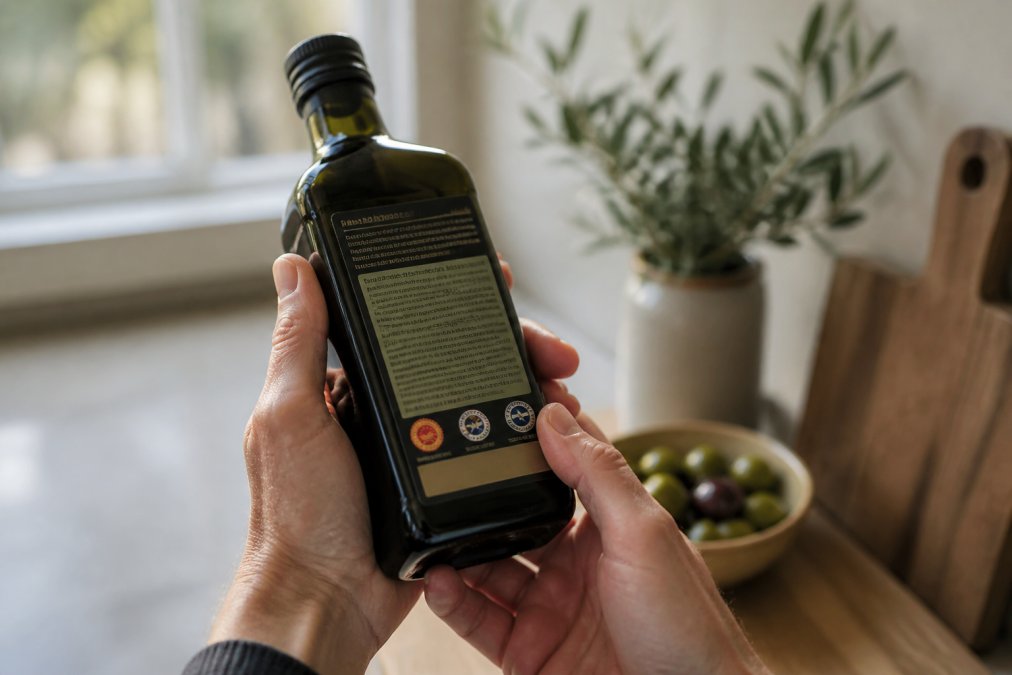
Three pieces of information on a Greek olive oil label tell you more than everything else combined: the harvest date, the PDO seal, and the olive variety. Reading them takes thirty seconds and saves you from paying top dollar for stale oil.
Why the Harvest Date Beats the Expiration Date
The harvest date tells you when the olives were pressed, and that is the number that matters. An expiration date is typically set two years out from bottling and says nothing about warehouse time.
What Protected Designation of Origin Tells You
A protected designation of origin, or PDO, is a legal certification that ties an oil to a specific region and to traditional production methods. It confirms the oil was produced, processed, and bottled in a defined area, making it far harder to pass off a blend as something it is not.
Why Koroneiki Is the Variety to Know
Koroneiki is the dominant olive cultivar in southern Greece, prized for small fruit that yields oil with high polyphenols and a bold, grassy character. Monovarietal Koroneiki oil is intense: green, peppery, and sometimes bitter in a way that signals quality. Such robust chemical profiles also lend themselves to the creation of artisan olive oil products that extend the benefits of these polyphenols well beyond the kitchen.
How to Store Olive Oil Properly Once You Get It Home
How to store olive oil properly comes down to four enemies: light, heat, air, and time. Most of the decline happens in your own kitchen, not on the shelf.
- Keep it dark. Store oil in its original dark glass or tin, or move it to a cupboard. Clear bottles on a sunny counter are the fastest way to ruin good oil.
- Keep it cool. A pantry away from the stove is ideal. Heat accelerates oxidation.
- Keep it sealed. Oxygen is the enemy. Cap the bottle tightly after every pour.
- Keep it small. Buy sizes you will finish within a few months. A large bottle that lasts a year will be stale by the end.
- Do not refrigerate for long storage. Cold can cause the oil to solidify and cloud, which is harmless but annoying. A cool cupboard beats the fridge.
The Best Olive Oil for Cooking vs Finishing
The best olive oil for cooking vs finishing is not the same bottle, and treating them as interchangeable wastes money. High-polyphenol, cold extracted oil is best used raw, where its flavor and antioxidants survive; a good everyday oil handles the pan. The more useful question is which Greek oil profile belongs on which dish, because a peppery Koroneiki and a softer Kalamata oil behave very differently on the plate.
| Use | Oil type | Why |
|---|---|---|
| Finishing, dipping, dressings | Fresh, high-polyphenol extra virgin (Koroneiki) | Flavor and antioxidants stay intact |
| Sautéing, roasting | Everyday extra virgin | Good flavor, lower cost per use |
| High-heat searing | Refined or "light" olive oil | Higher smoke point, neutral taste |
Pairing Greek Olive Oil Profiles to Food
Greek oils are not one flavor. Match the profile to the dish and the quality shows up immediately.
- Bold, peppery Koroneiki, the dominant cultivar of southern Greece, with a grassy, bitter, high-polyphenol character. Use it raw: drizzled over tomatoes, feta, or grilled fish, whisked into a vinaigrette, or finished over a bowl of white beans. Heat flattens its best qualities.
- Fruitier Kalamata, softer and rounder, with a riper olive flavor. Good for dipping, for baking into savory breads, and for dishes where a bitter edge would clash, such as delicate seafood or mild cheeses.
- Blended Greek extra virgin, the everyday workhorse. Roast vegetables, sauté greens, sear chicken, and dress a weeknight salad. You want flavor without spending finishing-oil money.
- Refined or "light" olive oil, neutral and high-heat. Reserve it for searing at high temperatures or for baking where you do not want olive flavor to dominate.
A Simple Rule for the Kitchen
Keep two bottles on the counter: one finishing oil with a recent harvest date and a named Greek origin, and one everyday extra virgin for the pan. Decant the finishing oil into a small dark bottle so you are not opening the main bottle every time, and replace it with the current harvest rather than stretching an old bottle into next year.
How to Spot a Counterfeit Bottle at Home
Counterfeit and mislabeled olive oil is common enough that shoppers need a few at-home checks. You cannot run a lab test, but you can catch the most frequent problems before you buy.
- Check the harvest date. A missing or vague date is a red flag.
- Look at the origin. "Packed in" or "bottled in" is not the same as "produced in." A single country or region is a better sign than a vague blend.
- Inspect the packaging. Dark glass or tin protects the oil. Clear plastic on a bright shelf is a bad sign.
- Read the grade. "Extra virgin" should be stated plainly, not implied with words like "premium" or "select."
- Trust your senses. Real extra virgin oil smells fresh and grassy, tastes peppery, and leaves a slight catch in your throat. Flat, waxy, or greasy oil has gone stale or was never good to begin with.
Price-to-Quality: What You're Actually Paying For
Price and quality track together in olive oil, but only up to a point. What you are really paying for is freshness, low yield, and traceability, not a fancy bottle.
Frequently Asked Questions
What is considered the best Greek olive oil?
The best Greek olive oil carries a specific harvest date within the last 12 to 18 months, comes in dark glass or a tin, and lists a single region or estate. Look for extra virgin grade, cold extracted, and ideally a Protected Designation of Origin seal. Koroneiki olives from Crete and the Peloponnese are the most common base for top-rated bottles. Price alone does not signal quality; a $25 bottle with a recent harvest date beats a $45 bottle with no date at all.
Which Greek olive oil has the highest polyphenol content?
Early harvest extra virgin olive oil from Koroneiki olives typically shows the highest polyphenol levels, because olives picked green in October and November retain more of these compounds than late-harvest fruit. Some producers print the polyphenol count in milligrams per kilogram on the label. If a bottle does not list it, look for terms like early harvest, cold extracted, and a harvest date in the fall. Bitterness and a peppery finish in the throat are signs polyphenols are still intact.
How can you tell if Greek olive oil is authentic?
Check three things: a harvest date, not just a best-by date; a specific region such as Crete, Kalamata, or Lesvos rather than just a country name; and a dark glass or tin container that blocks light. At home, pour a spoonful into a small glass, warm it in your hands, and smell. Fresh oil smells green, grassy, or like tomato leaf. If it smells waxy, like crayons, or like old nuts, it has gone rancid or was never fresh to begin with.
Does the harvest date matter when buying Greek olive oil?
The harvest date is the single most useful number on the bottle. Olive oil is a fresh juice, not a wine, and it loses flavor and antioxidants over time. A bottle harvested within the past 12 months tastes noticeably brighter than one from two or three years ago, even if both say best by a future date. Buy from the most recent harvest, store it away from heat and light, and use it within a few months of opening.