 ultimate-guide
Traditional Greek Food Portion Sizes: What to Expect
Table of Contents
- Are Greek Portions Bigger Than American Servings?
- Typical Portion Sizes for Classic Greek Dishes
- What Defines Authentic Greek Flavor in Portions
- Authentic Greek Dining Etiquette: How Sharing Works
- Ordering Strategies to Avoid Over-Ordering
- How Portion Sizes Fit a Mediterranean Diet
- Visual Portion Guide and Leftover Tips
- Conclusion
- Frequently Asked Questions
Last Updated: September 9, 2026
Greek restaurants in the United States are known for generous portions, but traditional serving sizes in Greece itself often tell a different story. Understanding traditional greek food portion sizes before you order means the difference between a balanced, satisfying meal and a table piled with leftovers you didn't plan for. At Gyro Kingdom, we serve authentic Greek cuisine made fresh daily. Below, we'll break down what a typical Greek meal actually looks like, how sharing works, and how to order wisely without wasting food.
The single most useful mindset shift is this: Greek dining is built around sharing small plates, not individual American-style entrees. Most visitors over-order because they treat a taverna menu like a standard restaurant where each person gets one main dish.
Are Greek Portions Bigger Than American Servings?
For most classic dishes, Greek portions are actually comparable to or slightly smaller than American restaurant servings. The perception that they are larger comes from the sheer number of dishes that arrive at the table when you order family-style.
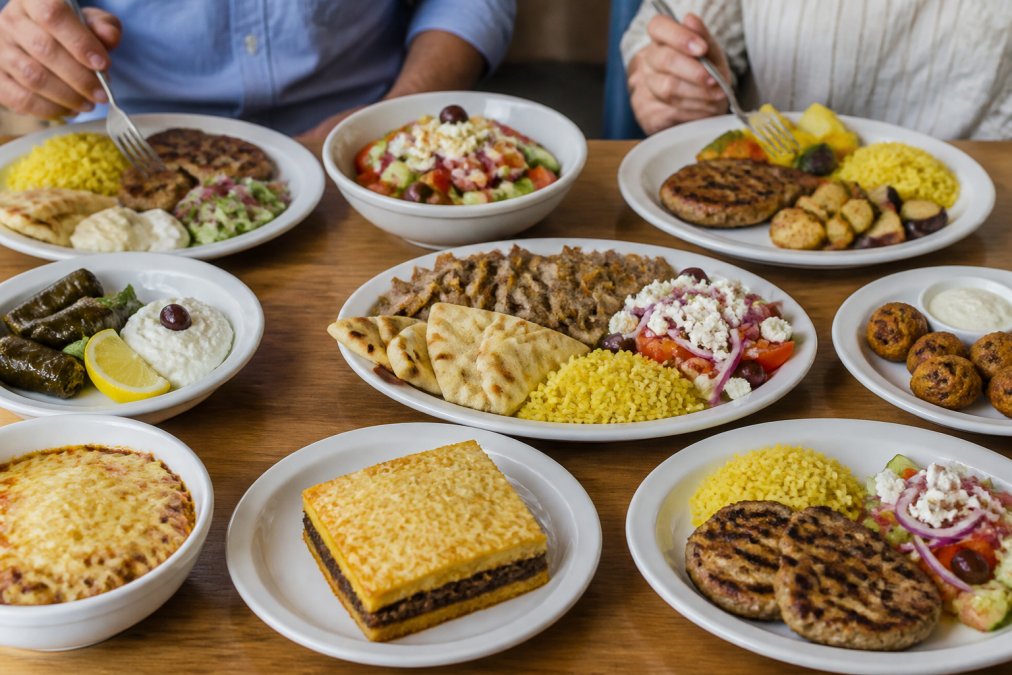
Traditional Greek dining centers on mezedes, which are small sharing plates meant to be passed around. A typical taverna meal for two might include three or four mezedes plus one shared main course. By contrast, an American diner expects one entree per person, often with a side. The total volume of food can look impressive on a Greek table, but the per-person portion is usually moderate and balanced with fresh vegetables, olive oil, and lean proteins.
Typical Portion Sizes for Classic Greek Dishes
Portion sizes vary by dish type, and knowing the rough breakdown helps you plan a balanced meal. Greek food portion sizes are designed around the Mediterranean principle of eating a variety of flavors in moderate amounts.
Mezedes and Appetizers
Mezedes are the heart of Greek social dining. A standard serving of tzatziki, melitzanosalata, or feta with olives is roughly a half-cup scoop, meant to be spread across pita bread and shared (the FDA). A portion of dolmades, stuffed grape leaves, typically comes as four to six pieces. Spanakopita and tiropita are usually served as single triangular pastries, which are denser than they look.
When ordering mezedes for a table of four, a good rule is two to three small plates per person. That means eight to twelve dishes total, which sounds excessive but works because each plate is modest in size.
Main Courses: Gyros, Souvlaki, and Moussaka
A classic gyros portion in Greece is one pita filled with roughly four to six ounces of sliced meat, tomato, onion, and tzatziki (usda.gov). It is a handheld meal, not a platter. Souvlaki is typically served as a skewer with about five to six ounces of meat, accompanied by a small salad and a wedge of lemon. Moussaka, being a heavier baked dish, is usually cut into a rectangular slice roughly three by four inches, served alongside a simple green salad.
What Defines Authentic Greek Flavor in Portions
Authentic Greek cuisine relies on fresh ingredients and simple preparation, and this directly shapes portion sizes. Dishes are built around olive oil, lemon, oregano, and herbs rather than heavy sauces or refined carbohydrates. This is what defines authentic greek flavor: the quality of the ingredients carries the dish, so portions do not need to be enormous to feel satisfying.
The Mediterranean diet, widely studied for its health benefits, emphasizes vegetables, legumes, fish, and olive oil with moderate portions of meat and dairy (the WHO). A traditional Greek plate reflects this balance. Even a filling gyros includes fresh tomato, onion, and tzatziki alongside the meat, giving you protein, produce, and healthy fat in one hand-held portion.
Authentic Greek Dining Etiquette: How Sharing Works
Authentic greek dining etiquette treats the table as a communal experience. When you order mezedes, the expectation is that everyone shares everything. You do not claim a dish as your own, and you pace yourself because more food is always coming.
A few practical customs to know:
- Bread is used to scoop dips and sauces, not as a separate side dish
- Salads are shared from a central bowl, not plated individually
- It is polite to offer dishes to others before taking a second serving
- The host or the person who suggested the restaurant typically orders first
Ordering Strategies to Avoid Over-Ordering
The standard advice, "start small and add more", is sound, but it misses a key piece of traveler intelligence: how to read portion size against price to know if you are getting authentic value or paying tourist-trap markup. Here is how to order smart and avoid both over-ordering and over-paying.
The Two-Plate Rule for Newcomers
If you are unfamiliar with Greek taverna portions, the safest strategy is the Two-Plate Rule: order two mezedes per person and one shared main for every two people. This gives you variety without excess. For a table of two, that means four mezedes and one main. For a table of four, eight mezedes and two mains. This formula works because mezedes are meant to be shared, and the main acts as a centerpiece, not an individual entree.
The Price-to-Portion Reality Check
Here is the angle most guides miss: portion size is a reliable signal of whether you are in a tourist spot or a local favorite. In authentic Greek restaurants, prices reflect the quality of ingredients, not the volume of food.
The Menu Signal Test
Before you order, scan the menu for these signals:
- Mezedes priced under $6: Likely frozen or pre-made, not fresh. Authentic small plates usually run $8 to $14 in U.S. Greek restaurants.
- Mains over $25: You are paying for ambiance or location, not traditional cooking. Authentic souvlaki or moussaka should be in the $15 to $22 range.
- "Family-style" or "feast" options: These are often designed to maximize per-person spend. You will almost always pay less by ordering a la carte mezedes.
The Solo Traveler's Playbook
Eating alone at a Greek restaurant does not mean you must order a full main. The smart move is to order two mezedes and a side salad. This gives you three distinct flavors and a balanced meal for roughly the same price as one entree. If you want a main, ask if they serve a half-portion, many tavernas will accommodate this request, especially for lighter eaters.
The "Ask the Server" Strategy
Servers in authentic Greek restaurants are used to visitors over-ordering. A direct question works well: "If you were eating here tonight, what would you order for two people?" This usually gets you an honest, portion-appropriate recommendation.
How Portion Sizes Fit a Mediterranean Diet
Greek food portion sizes align naturally with Mediterranean diet principles, which makes this cuisine a strong option for health-conscious diners. The diet prioritizes vegetables, fruits, whole grains, legumes, and olive oil, with fish and poultry in moderation. Red meat and sweets appear occasionally.
A balanced Greek meal delivers protein from lamb, chicken, or legumes, healthy fats from olive oil and feta, and fiber from vegetables and pita. Because portions are moderate and ingredient-driven, you get nutritional value. For anyone tracking protein content or trying to limit refined carbohydrates, a souvlaki skewer with a Greek salad is a straightforward, balanced choice.
Visual Portion Guide and Leftover Tips
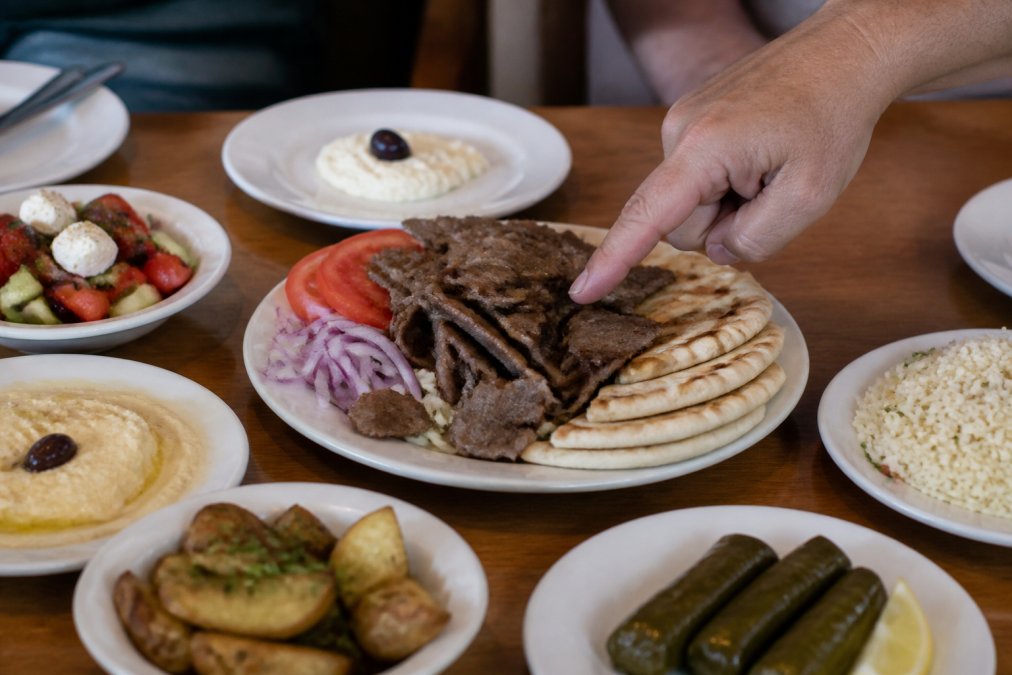
Words like "moderate" only get you so far. Here is a practical, visual translation of traditional Greek portion sizes using everyday objects you already know. This is the cheat sheet for building a balanced plate without over-ordering.
The Deck of Cards Rule for Protein
A standard portion of grilled meat, whether it's souvlaki, gyros meat, or a lamb chop, is about the size of a deck of cards (3 ounces cooked) or slightly larger at 4 to 5 ounces. On a standard 10-inch dinner plate, that protein should cover no more than a quarter of the surface. If the meat overlaps your salad or touches the edge of the plate, you are likely looking at a double portion.
The Fist Rule for Starches
A serving of rice, roasted potatoes, or orzo should be about the size of your closed fist (roughly 1 cup). For pita bread, one standard round (about 6 inches in diameter) is a single serving. When a basket of pita arrives at the table, it is meant to be shared, not consumed by one person.
The Thumb Rule for Fats and Sauces
A serving of olive oil for dipping is about the size of your thumb (1 tablespoon). Tzatziki, melitzanosalata, or hummus should be a dollop about the size of a golf ball (roughly 2 tablespoons) per person when used as a spread or dip. If a bowl of sauce arrives that is larger than your palm, treat it as a shared condiment, not an individual side.
The Plate Composition Check
A traditional Greek plate follows a simple visual formula: half the plate is vegetables (salad, grilled veggies, or greens), a quarter is protein, and a quarter is starch. When you order a gyros platter, the meat should not dominate. If it does, you are getting an Americanized portion, not a traditional one.
Leftover Logistics: The Doggy Bag Question
A common concern for travelers is whether it is acceptable to ask for a takeaway container. In casual tavernas and street food spots, it is perfectly fine to ask for a box ("parakalo, ena kouti"). In more formal sit-down restaurants, the custom is less universal. A good rule: if you are in a casual setting or a family-run spot, asking is fine. In a white-tablecloth restaurant, it is often better to leave the food or order less next time. When you do take leftovers, most Greek dishes, moussaka, pastitsio, stews, can be enjoyed later. Gyros and souvlaki are best eaten fresh, but the meat can be reheated in a hot skillet for two to three minutes per side to restore crispness.
Conclusion
Greek dining rewards those who embrace sharing and moderation. The generous spread on the table comes from variety, not oversized individual portions, and the cuisine's reliance on fresh ingredients makes it both satisfying and balanced.
Frequently Asked Questions
Are portion sizes in Greece typically larger than in the US?
No, it's often the opposite. Traditional Greek food portion sizes at local tavernas tend to be more moderate than the large servings common in US restaurants. Greek meals are built around fresh ingredients, olive oil, and sharing plates, which naturally controls how much you eat. US Greek restaurants, however, often adapt to local expectations and serve bigger portions. When you order, think about sharing a few dishes rather than expecting one massive entree.
What is the typical serving size for a Greek salad?
A traditional Greek salad, or horiatiki, is typically served as a side dish meant for one person, featuring a generous slice of feta on top. It's not a massive bowl of greens. The portion focuses on tomatoes, cucumber, olives, and peppers dressed in olive oil. As a main course, you might get a larger version, but in Greece it often comes to the table to be shared among two or more diners.
Is it common to share plates when eating traditional Greek food?
Yes, sharing is central to authentic Greek dining etiquette. Diners order several mezedes, or small plates, and share them family-style in the middle of the table. This approach lets everyone sample more flavors without committing to a single large entree. If you want to try multiple dishes without over-ordering, pick two or three mezedes and one main to split, then add more only if everyone is still hungry.
What defines a standard portion for a gyro or souvlaki?
A standard gyro portion is one pita sandwich, generously stuffed with seasoned meat, tomato, onion, and tzatziki. Souvlaki is usually served as a skewer, with two skewers considered a full meal in many tavernas. These portions are filling but not oversized. If you're hungry, add a side of Greek salad or fries rather than ordering a second sandwich, which often leads to leftovers.
Planning a Greek meal in the Brick, NJ area? Gyro Kingdom serves freshly made gyros daily with your choice of chicken, lamb, beef, or pork, alongside other traditional Mediterranean classics. Our team is dedicated to a welcoming atmosphere and generous portions that deliver a memorable dining experience. Try it today and taste authentic Greek cuisine without leaving the Jersey Shore.