 comparison
Greek vs Mediterranean Cuisine: Key Differences
Table of Contents
- Is Greek Food Mediterranean? Understanding the Relationship
- Mediterranean Cuisine Countries and Geographic Scope
- Greek Food Ingredients That Define the Cuisine
- Herbs, Spices, and Flavor Profiles: Greek vs Broader Mediterranean
- Traditional Greek Dishes and Mediterranean Classics Compared
- Proteins, Preparation Methods, and Cooking Traditions
- Why Choose Authentic Greek Cuisine Over Broader Mediterranean
- Frequently Asked Questions
Last Updated: October 9, 2026
Is Greek Food Mediterranean? Understanding the Relationship
Greek vs Mediterranean cuisine represents a distinction where Greek cuisine is a national cuisine within the broader Mediterranean food tradition. It emphasizes specific ingredients, preparation methods, and flavor profiles that set it apart from other Mediterranean cuisines, even though they share common roots.
At Gyro Kingdom, we serve authentic Greek cuisine, with dishes prepared using methods and ingredients that define Greek food specifically, not a generalized Mediterranean approach.
The relationship between Greek and Mediterranean cuisine is like jazz and American music: jazz is American, but not all American music is jazz. Similarly, Greek food is Mediterranean, but not all Mediterranean food is Greek. Understanding this distinction guides you toward the right restaurant when you're craving authentic flavors.
Mediterranean Cuisine Countries and Geographic Scope
"Mediterranean cuisine" is not a single tradition with a rulebook. It is a shorthand label for the cooking of the countries bordering the Mediterranean Sea, and it is looser than most restaurant menus suggest.
Southern Europe (northern shore): Greece, Italy, Spain, Portugal, France (Provence and the Riviera), and Malta. This is the group most diners picture when they hear "Mediterranean food." Olive oil, wine, wheat, and tomatoes dominate.
The Levant (eastern shore): Lebanon, Syria, Israel, Palestine, and Jordan. Mezze culture, sesame (tahini), chickpeas, and layered warm spices define this group.
Anatolia and the eastern Aegean: Turkey. Turkish cooking sits at a crossroads, it shares grilled meats and yogurt with Greece, but leans harder on cumin, sumac, and bulgur.
North Africa (southern shore): Morocco, Algeria, Tunisia, and Egypt. Couscous, harissa, preserved lemons, and dried fruit appear here in ways they do not in Greece or Italy.
That is roughly 20 countries and territories across three continents and at least three climate bands. Growing seasons, available proteins, and historical trade routes all differ, which is why "Mediterranean cuisine" produces everything from Moroccan tagine to Provençal ratatouille to Greek moussaka.
Two boundary questions come up constantly:
- Is Portugal Mediterranean? It has an Atlantic coastline and no Mediterranean shore, but its cooking shares the olive-oil, seafood, and tomato backbone of the region. Many food writers include it; strict geographers do not.
- Are the Balkans Mediterranean? Croatia, Albania, and Montenegro have Adriatic coastlines and Mediterranean-style coastal cooking, but their inland cuisines are shaped by Central European and Ottoman influences. The label usually applies only to the coastal strip.
Greek cuisine, by contrast, has a hard boundary: the cooking of Greece and the Greek diaspora, with regional variation inside the country (see below). A "Mediterranean" restaurant usually draws from the southern European and Levantine groups, Italian pasta, Spanish tapas, Turkish kebabs, Lebanese mezze, and may or may not include Greek dishes.
Mediterranean diet and cuisine background
Greek Food Ingredients That Define the Cuisine
Greek cuisine relies on a core set of fresh ingredients. Olive oil is the foundation, used generously in nearly every savory dish. Tomatoes, cucumbers, and bell peppers base many salads and sauces.
Fresh herbs distinguish Greek food from broader Mediterranean traditions. Oregano is ubiquitous, dried or fresh, adding a peppery note. Dill appears frequently in fish dishes and vegetable preparations, with mint and parsley rounding out the profile.
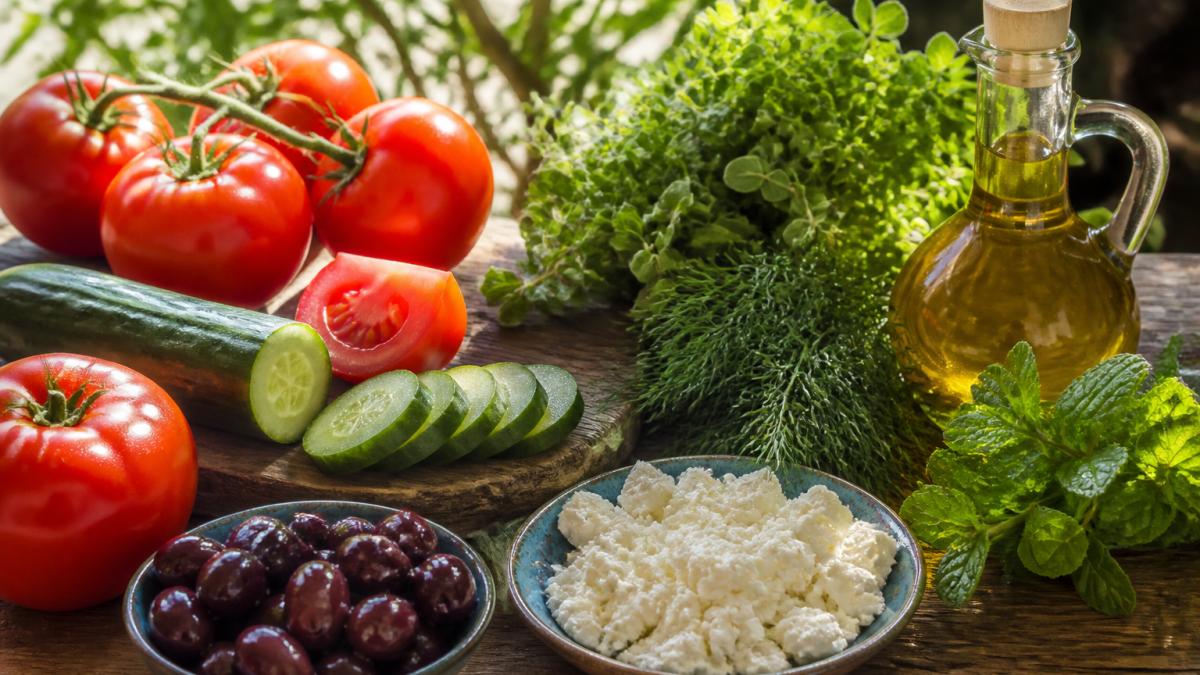
Legumes like lentils and chickpeas provide protein and substance. Garlic and onions build flavor foundations, while lemons add brightness and acidity. Together they create bold, fresh flavors that depend on quality and simplicity rather than complex techniques.
The Greek ingredient list is short and accessible, and the cooking philosophy lets quality ingredients shine rather than masking them with heavy sauces. At Gyro Kingdom you taste this directly: our gyros use fresh meat and traditional spices.
Herbs, Spices, and Flavor Profiles: Greek vs Broader Mediterranean
Greek cuisine uses a spice and herb palette that differs noticeably from other Mediterranean traditions. Oregano dominates Greek cooking in a way it doesn't in Italian or Spanish cuisines, and dill appears regularly in Greek dishes but rarely in those. This herb-forward approach creates a distinctly Greek flavor profile.
Broader Mediterranean cuisines use different herbs and spices based on regional trade history and agriculture. Italian cooking emphasizes basil, rosemary, and thyme; Spanish food uses saffron, cumin, and smoked paprika; Turkish and Lebanese cuisines draw on cumin, coriander, and cinnamon.
The resulting flavor profiles are distinctly different. Greek food tastes fresh and herb-forward, with bright acidity from lemon and tomato. Italian Mediterranean food tends toward richer, garlic-and-herb flavors; Spanish Mediterranean food incorporates warm spices and smoky notes; Turkish and Lebanese Mediterranean cuisines use warm spices and layered combinations.
When you taste Greek food, you should notice the immediate impact of oregano and dill, the brightness of lemon, and the simplicity of preparation, deliberate ingredient choices that define Greek cuisine specifically in Greek vs Mediterranean cuisine comparisons.
Traditional Greek Dishes and Mediterranean Classics Compared
The clearest way to separate Greek food from the broader Mediterranean label is to compare dishes that look similar on a menu but are built differently in the kitchen. The table below pairs each Greek dish with a Mediterranean cousin and explains the structural difference, not just the ingredient list.
| Greek dish | Closest Mediterranean cousin | What actually differs |
|---|---|---|
| Moussaka (eggplant, ground lamb or beef, béchamel) | Italian melanzane alla parmigiana | Greek moussaka is a layered casserole bound with béchamel and often potato; the Italian version is sliced eggplant with tomato and cheese, no béchamel, no potato. |
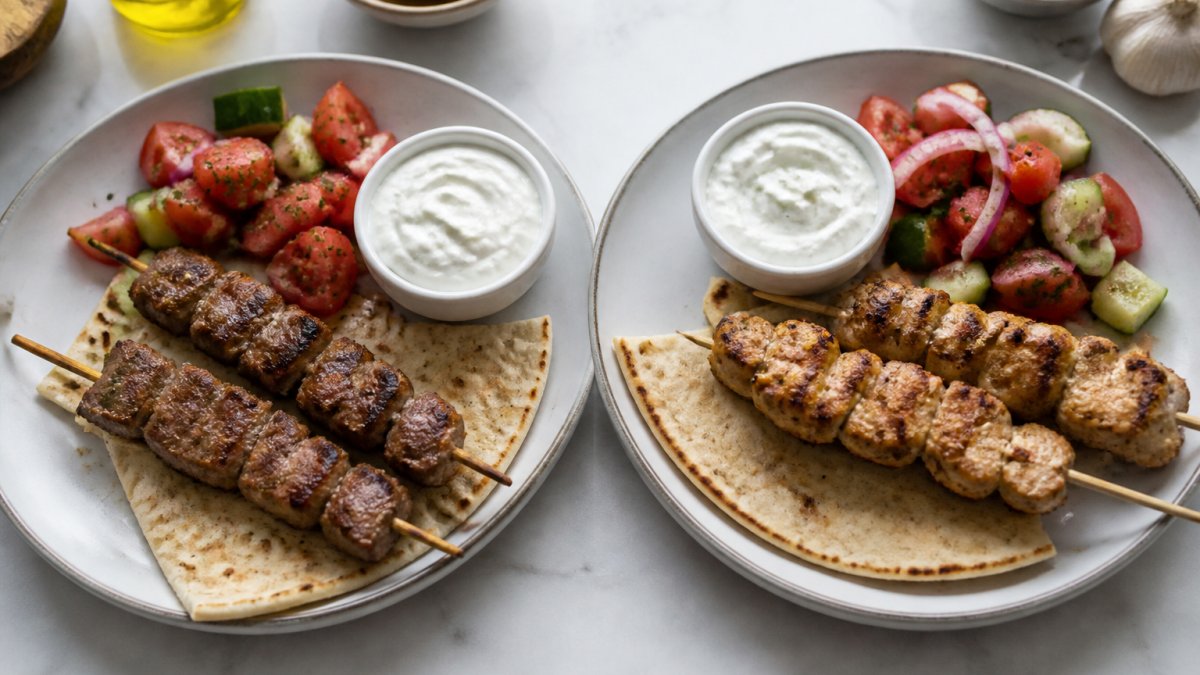
| Souvlaki (skewered pork or chicken, oregano, lemon) | Turkish şiş kebab | Both are grilled skewers. Greek souvlaki is marinated in lemon, oregano, and olive oil and served in pita with tzatziki; Turkish şiş leans on cumin, paprika, and is often served over rice or flatbread without yogurt sauce. |
| Spanakopita (spinach, feta, phyllo) | Levantine spinach fatayer | Both wrap spinach in pastry. Greek spanakopita uses paper-thin phyllo brushed with olive oil or butter and includes feta; fatayer uses a yeast dough and often includes pine nuts and lemon. |
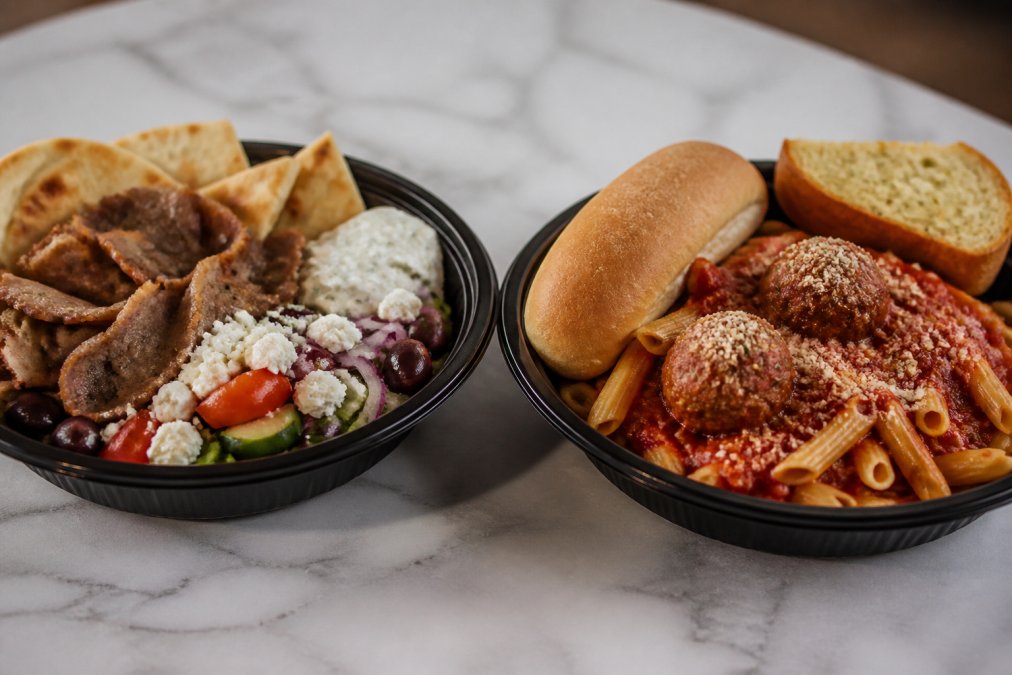
| Pastitsio (baked pasta, meat sauce, béchamel) | Italian pasticcio or lasagna | Greek pastitsio uses thick tubular pasta (bucatini or ziti), a cinnamon-and-clove-spiced meat sauce, and a béchamel top. Italian lasagna uses flat sheets and tomato-forward ragù without the sweet spice. |
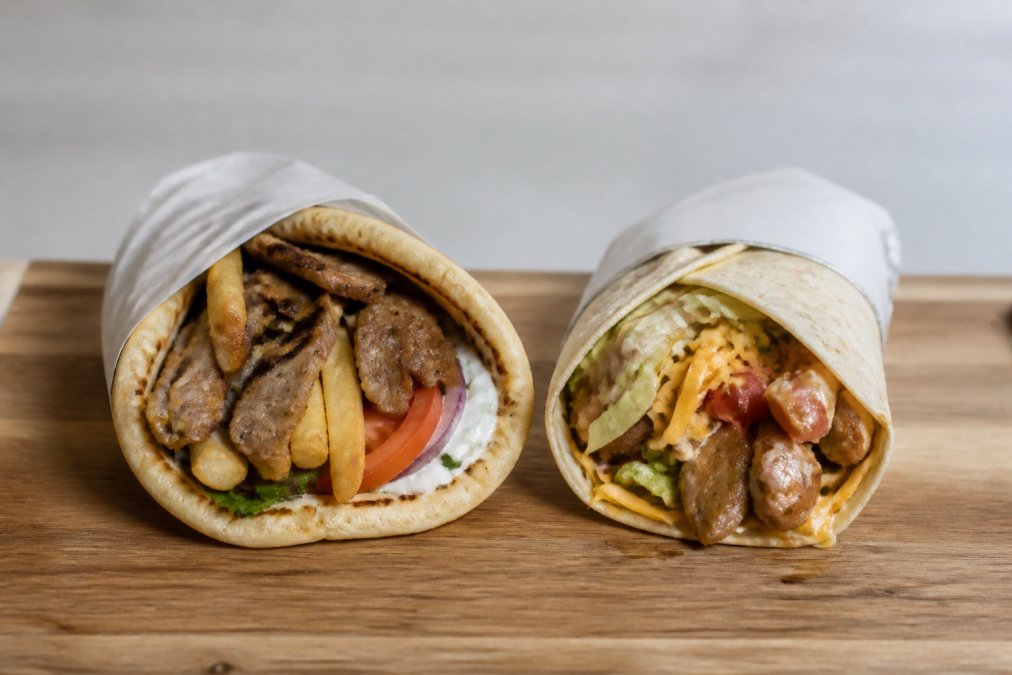
| Gyro (vertical rotisserie meat, pita, tzatziki) | Lebanese shawarma or Mexican al pastor | All three use a vertical spit. Greek gyro is typically pork or chicken seasoned with oregano and lemon; shawarma uses lamb, beef, or chicken with seven-spice and tahini; al pastor uses pork with achiote and chili. |
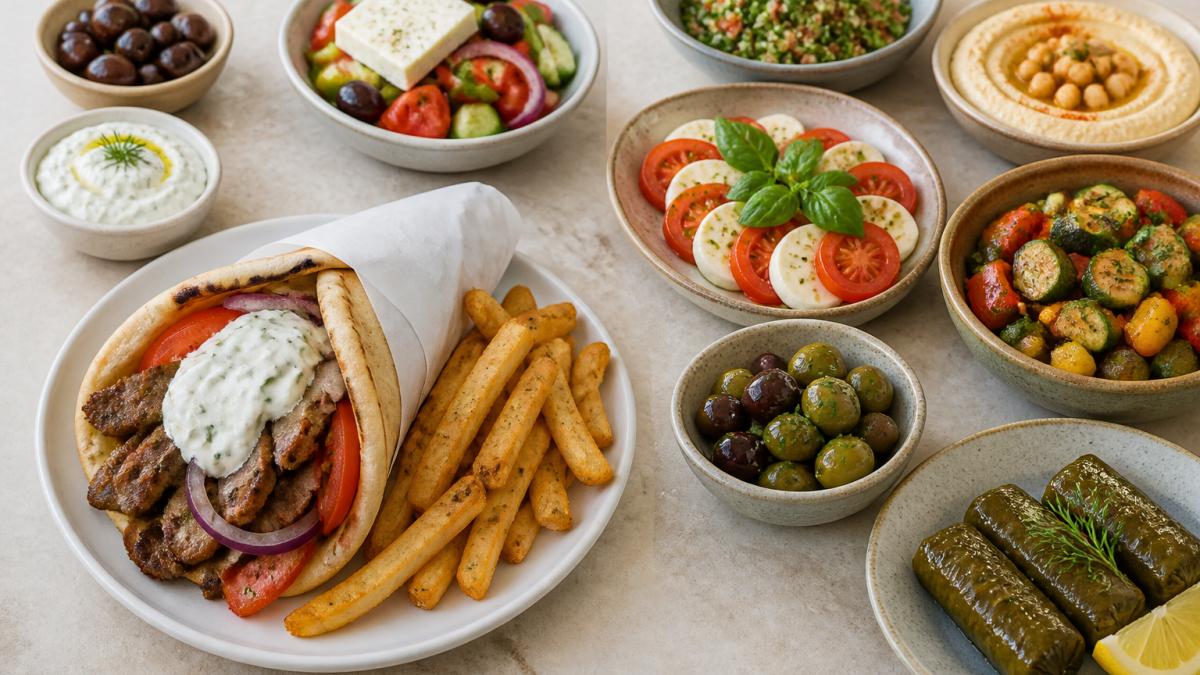
| Horiatiki ("village salad": tomato, cucumber, onion, olives, feta, oregano) | Lebanese fattoush or Italian panzanella | Horiatiki has no lettuce and no dressing beyond olive oil and oregano; fattoush adds toasted pita and sumac; panzanella adds soaked bread and vinegar. |
Two patterns fall out of that comparison. First, Greek versions tend to use fewer spices and lean on oregano, dill, lemon, and olive oil rather than the warm-spice blends (cumin, cinnamon, sumac, harissa) that define Turkish, Levantine, and North African cooking.
Regional variation inside Greece matters too. Greek cuisine is not uniform, and treating it as one flavor profile is the same mistake as treating "Mediterranean" as one cuisine:
- Crete and the southern Aegean: the most olive-oil-heavy cooking in Greece, with wild greens (horta), snails, and a strong reliance on legumes and barley rusks (paximadia).
- The Peloponnese: known for pork, oranges, olives, and the cured pork sausage loukaniko.
- Northern Greece (Macedonia, Epirus): heartier, more Balkan-influenced, pites (savory pies), peppers, and paprika appear more often than in the south.
- The Ionian Islands: Italian influence shows up in pastitsada and sofrito, dishes you will not find in Athens.
- The eastern Aegean islands: proximity to Turkey produces shared dishes like stuffed vine leaves and grilled octopus with a Turkish-adjacent spice profile.
So when you compare a Greek menu to a Mediterranean menu, you are really comparing a specific national cuisine with internal regional variation against a broad, multi-country label. That is why a Greek restaurant can serve a dish a Mediterranean restaurant also serves, and still have it taste different.
Proteins, Preparation Methods, and Cooking Traditions
Greek cuisine traditionally emphasizes lamb, reflecting Greece's pastoral history; it appears in moussaka, pastitsio, and grilled preparations. Seafood, particularly octopus and white fish, features prominently in coastal regions. Chicken appears less frequently than in some Mediterranean traditions, and pork is used in sausages and certain regional dishes.
Greek preparation methods tend toward simplicity: grilling over open flame, roasting with olive oil and herbs, braising in tomato sauce, and frying in olive oil. These methods emphasize ingredient quality rather than complex technique.
Broader Mediterranean cuisines use different proteins based on regional availability and cultural preference. Italian cuisine uses pork, beef, and seafood with equal emphasis. Spanish cooking incorporates more seafood than Greek traditions. Turkish and Lebanese cuisines use lamb and chicken more frequently than Greek food uses chicken.
The cooking traditions also differ. Italian cuisine emphasizes slow cooking and long simmering; Spanish cooking adds frying and stewing alongside grilling; Turkish and Lebanese cuisines use spice layering and longer cooking times to develop depth.
At Gyro Kingdom, we use traditional Greek preparation methods for everything we serve. Our gyros cook on a vertical rotisserie, a method used in Greece for generations.
Why Choose Authentic Greek Cuisine Over Broader Mediterranean
Choosing authentic Greek cuisine means getting dishes prepared according to Greek culinary traditions rather than a generalized Mediterranean approach, specific dishes, ingredient combinations, and cooking methods refined over centuries within Greece itself.
When you want authentic Greek food, look for restaurants that specialize in Greek cuisine rather than broad Mediterranean food.
Broader Mediterranean restaurants may serve some Greek dishes alongside Italian, Spanish, and Turkish options.
At Gyro Kingdom, we focus exclusively on authentic Greek cuisine because specialization matters. Our team understands Greek culinary traditions deeply, knows which ingredients matter most, and uses traditional preparation methods.
The choice between authentic Greek cuisine and broader Mediterranean food comes down to what you're craving. For the distinct flavors of oregano, dill, and lemon with fresh ingredients and simple preparation, choose Greek.
For residents of Brick and Ocean County seeking authentic Greek food, Gyro Kingdom delivers the genuine article. Our gyros, traditional Greek dishes, and Mediterranean classics reflect Greek culinary heritage, with the fresh ingredients and bold flavors that define Greek cuisine.
When you're ready to experience authentic Greek cuisine prepared with fresh ingredients and traditional methods, visit Gyro Kingdom.
Frequently Asked Questions
Is Greek food the same as Mediterranean food?
No. Greek cuisine is a national cuisine within the broader Mediterranean category. Greek food emphasizes simplicity, freshness, and specific ingredients like feta, oregano, and dill. Mediterranean cuisine spans multiple countries, Italy, Spain, Turkey, Lebanon, and others, each with distinct traditions. Greek food is Mediterranean, but not all Mediterranean food is Greek. Think of it as Greek being a specific subset of a larger culinary region.
What are the main Greek food ingredients that set it apart?
Greek cuisine relies heavily on olive oil, feta cheese, fresh vegetables (tomatoes, cucumbers, eggplant), and herbs like oregano, dill, and mint. Seafood, lamb, and chicken are primary proteins. The focus is on fresh, seasonal ingredients prepared simply to let flavors shine. Other Mediterranean cuisines use broader spice profiles, cumin, coriander, saffron, and different cheeses, giving them distinct tastes even when ingredients overlap.
Are gyros considered Mediterranean food?
Yes, gyros are Greek and therefore Mediterranean. A gyro is a traditional Greek dish made with seasoned meat (chicken, lamb, pork, or beef) cooked on a vertical rotisserie, then wrapped in pita with fresh vegetables and tzatziki sauce. It represents authentic Greek cuisine with Mediterranean roots. At Gyro Kingdom, we prepare gyros fresh daily using quality ingredients, staying true to traditional Greek preparation methods that honor Mediterranean culinary heritage.
Which Mediterranean countries have the most different cuisines from Greek?
Lebanese and Turkish cuisines differ significantly from Greek food despite sharing the Mediterranean region. Lebanese cuisine emphasizes spices like cumin and coriander, with dishes like hummus and kibbeh. Turkish cuisine blends Middle Eastern and Mediterranean influences with kebabs and unique spice blends. Italian cuisine focuses on pasta, risotto, and tomato-based sauces. Spanish cuisine features paella and seafood preparations. While all are Mediterranean, each nation's cuisine reflects its own cultural, historical, and agricultural influences, making Greek food distinctly recognizable among Mediterranean options.