 how-to
How to Slice Gyro Meat Perfectly
Table of Contents
- Why Slicing Technique Matters for Gyro Meat
- Preparing Your Gyro Meat: Cooling and Resting
- Best Knife for Slicing Gyro Meat
- How Thin to Slice Gyro Meat for Authentic Results
- How to Keep Gyro Meat from Crumbling When Slicing
- Slicing Techniques for Different Gyro Cooking Methods
- How to Reheat Sliced Gyro Meat Without Drying It Out
- Common Mistakes to Avoid When Slicing Gyro Meat
- Frequently Asked Questions
Last Updated: October 10, 2026
Why Slicing Technique Matters for Gyro Meat
Mastering how to slice gyro meat perfectly determines whether your gyro stays together or falls apart, and whether each bite tastes consistent.
A properly sliced gyro stays together on flatbread, absorbs sauce evenly, and delivers consistent bites.
Slice thickness affects texture, flavor absorption, and how well the meat fits in pita bread.
Cold meat holds its shape and yields precise cuts, which is why cooling and resting before slicing is essential.
Preparing Your Gyro Meat: Cooling and Resting
Freshly cooked gyro meat is too soft to slice cleanly because proteins haven't fully set and heat makes fibers prone to tearing.
Allow your cooked gyro meat to cool completely at room temperature for 30-45 minutes.
Overnight resting allows proteins to fully set, moisture to redistribute evenly, and the meat to become easier to cut into uniform slices.
Remove the meat from the refrigerator 10-15 minutes before slicing to reach an ideal cutting temperature.
Best Knife for Slicing Gyro Meat
A long, sharp blade is essential for slicing gyro meat cleanly. The best tool depends on your cooking setup and volume.
Long Slicing Knife or Carving Knife (8-10 inches)
A carving knife (8-10 inches long) is ideal for home cooks. The length allows smooth, continuous strokes rather than sawing, reducing tearing.
Best for: Home cooks slicing 1-4 portions; baked or pan-cooked gyro loaves; occasional use.
Electric Knife
An electric knife reduces pressure and prevents compression-related crumbling, but produces slightly more ragged edges and is overkill for small batches.
Best for: Large batches (6+ portions); cooks with limited hand strength; those who prefer consistent, effortless cuts.
Commercial Gyro Knife or Meat Slicer
A manual meat slicer produces uniform slices with exact thickness control, but costs $50-$200 and requires storage and cleanup.
Best for: Frequent gyro makers; those who value consistency above all; anyone slicing more than one loaf per week.
Serrated Blades: When to Avoid Them
Serrated blades shred meat rather than cut cleanly; use smooth blades for tender interior.
Knife Maintenance and Sharpness
Sharpness is non-negotiable. Hone before each use with a honing steel (30 seconds) and sharpen every 2-3 months with a whetstone or professional service. Store properly and hand wash immediately. Test sharpness by slicing a tomato; a sharp blade glides through with minimal pressure.
Blade Angle During Slicing
Hold your knife at a 45-degree angle to the meat's surface for clean, even cuts without excessive pressure.
How Thin to Slice Gyro Meat for Authentic Results
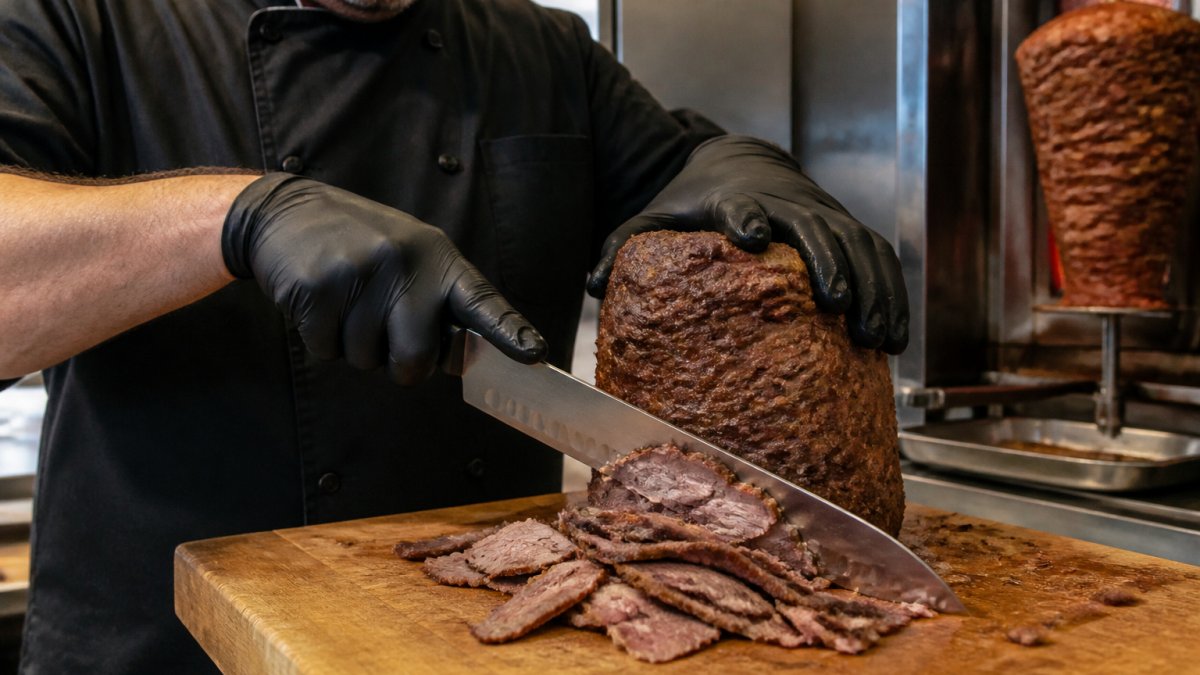
Ideal thickness is 1/8 inch to 1/4 inch (roughly two stacked credit cards). Thinner slices tear easily; thicker slices feel tough and don't absorb sauce well.
Aim for about 3/16 inch for structural integrity, tenderness, sauce absorption, and even reheating.
Stack two credit cards for a 1/8-inch reference; aim for 1.5 times that thickness. Consistency matters as much as thickness, use smooth, continuous strokes rather than short, choppy cuts.
How to Keep Gyro Meat from Crumbling When Slicing
Crumbly meat signals inadequate cooling, a dull knife, or wrong slicing angle. Overnight refrigeration is essential, warm meat crumbles regardless of knife quality.
Use smooth, continuous strokes with the full blade length.
If meat warms during slicing, it becomes prone to crumbling. Slice quickly and return unused portions to the refrigerator immediately.
Ensure overnight refrigeration, use a sharp long-bladed knife, make smooth single-stroke cuts, maintain cold temperature, and slice with the grain.
Slicing Techniques for Different Gyro Cooking Methods
Different cooking methods require slightly different slicing approaches. The meat's texture varies depending on how you prepared it.
Slicing from a Vertical Rotisserie Spit
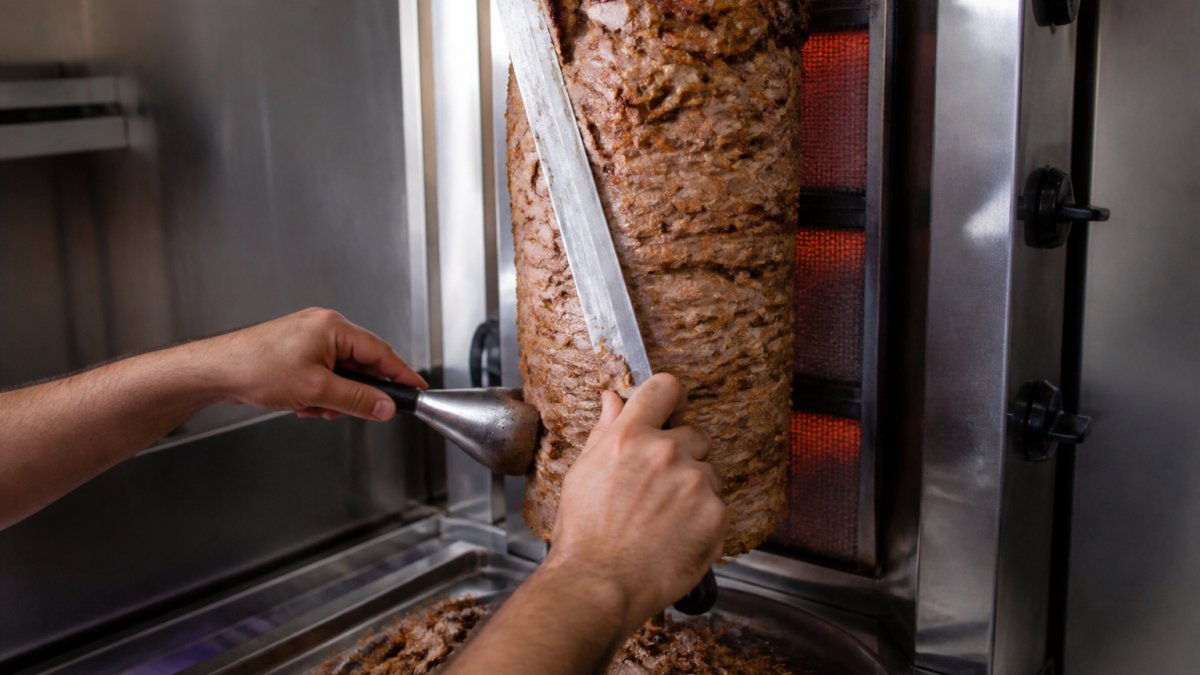
Cool rotisserie meat fully before removing from the spit. Slice downward and slightly outward with a sharp, long-bladed knife, working from outside to inside. Keep charred pieces for authentic flavor.
Slicing Baked or Pan-Cooked Gyro Meat
Baked meat has uniform texture but may be drier than rotisserie meat. Slice just before serving and store in an airtight container with a damp paper towel to maintain moisture.
How to Reheat Sliced Gyro Meat Without Drying It Out
Reheating sliced gyro meat requires care. High heat dries out the meat quickly. Low, gentle heat preserves tenderness and moisture.
The best reheating method is a skillet over medium heat.
For faster reheating, add a small amount of water or olive oil to the skillet.
Reheating methods:
- Skillet over medium heat: 2-3 minutes per side
- Oven at 350°F: 8-10 minutes covered with foil
- Microwave: 30-45 seconds (less ideal, but quick)
- Stovetop with sauce: warm with tzatziki or other sauce
Never use high heat or a microwave at full power. Both methods dry out the meat rapidly.
Avoid reheating more than once. Each reheating cycle removes moisture and toughens the meat.
Common Mistakes to Avoid When Slicing Gyro Meat
When slicing goes wrong, the result is obvious, but the cause isn't always clear. Use this troubleshooting guide to identify what went wrong and how to fix it next time.
Problem: Crumbly, Falling-Apart Slices
Most likely cause: Meat was sliced while still warm, or it wasn't refrigerated long enough.
Diagnostic check: If the meat crumbles immediately when you cut it, or if pieces fall off the slice as you lift it, the meat is too warm or hasn't set properly.
Fix:
- Allow cooked gyro meat to cool completely at room temperature (30-45 minutes)
- Refrigerate for at least 2-4 hours; overnight is ideal
- Remove from the refrigerator only 10-15 minutes before slicing
- If you're mid-slicing and the meat warms up, return unused portions to the refrigerator immediately
- Slice in batches rather than all at once for large quantities
Prevention: Never slice warm meat. Cold meat holds its shape and yields precise cuts.
Problem: Ragged, Torn, or Shredded Slices
Most likely cause: Your knife is dull, or you're using a serrated blade.
Diagnostic check: If the knife requires heavy downward pressure, or if the cut edge looks fuzzy or frayed rather than clean, your blade is dull.
Fix:
- Hone your blade with a honing steel before the next slicing session (30 seconds)
- If honing doesn't restore sharpness, sharpen with a whetstone or take the knife to a professional sharpener
- Switch to a smooth-bladed carving knife or chef's knife (at least 8 inches long)
- Test the blade on a tomato or piece of paper; a sharp knife should glide through with minimal pressure Maintaining such precision over time often requires an upgrade to professional culinary knives that hold a refined edge through repeated use.
Prevention: Hone before every use. Sharpen every 2-3 months if you slice regularly. A sharp blade does the work; you should never need to press hard.
Problem: Uneven Slice Thickness
Most likely cause: You're using short, choppy cutting motions instead of smooth, continuous strokes.
Diagnostic check: If some slices are paper-thin while others are chunky, or if the thickness varies within a single slice, your technique is inconsistent.
Fix:
- Use the full length of your blade in one smooth motion
- Let gravity and the blade's sharpness do the work; don't press down hard
- Maintain a consistent 45-degree angle throughout each cut
- Slice at a steady pace, rushing leads to uneven pressure and thickness
- For maximum consistency, consider a manual meat slicer with a thickness guide (especially for batches of 6+ portions)
Prevention: Practice with a few test slices before committing to the whole loaf. Aim for each slice to be roughly the thickness of two stacked credit cards (about 1/8 inch) to 1.5 times that thickness (about 3/16 inch).
Problem: Tough, Chewy Slices
Most likely cause: Slices are too thick, the meat was overcooked, or you're slicing against the grain.
Diagnostic check: If you have to chew hard and the meat feels dense, the slices are likely thicker than 1/4 inch, or the meat loaf was cooked too long at high heat.
Fix:
- Aim for a thickness of 1/8 inch to 1/4 inch (ideally 3/16 inch)
- When reheating, use medium heat and cover the skillet to trap steam; avoid high heat or prolonged cooking
- Slice with the grain (parallel to the long muscle fibers) rather than against it; this keeps fibers intact and reduces chewiness
- If the meat loaf was overcooked, there's no fix, but next time, monitor internal temperature (160°F for beef, 165°F for poultry) and remove from heat immediately
Prevention: Slice thinner if you prefer tender bites. Use a meat thermometer during cooking to avoid overcooking. Always slice with the grain.
Problem: Slices Fall Apart When You Pick Them Up
Most likely cause: The meat lacks adequate fat content, or it's too cold (below 35°F).
Diagnostic check: If slices are structurally weak and separate into fragments when you lift them, the meat is either very lean or it's been over-chilled.
Fix:
- Remove the meat from the refrigerator 10-15 minutes before slicing to bring it to an ideal cutting temperature (around 40-45°F)
- If the meat is very lean, ensure it's been properly rested overnight so proteins fully set and stabilize
- Consider adding a small amount of fat (olive oil or butter) when reheating to improve texture
- Slice just before serving to minimize exposure to air, which dries out the meat
Prevention: Gyro meat with adequate fat content (typically 15-20% fat) holds together better. If you're making gyro at home, don't trim all the fat.
Problem: Meat Sticks to the Knife
Most likely cause: The blade is wet or the meat is too warm.
Diagnostic check: If slices cling to the blade and don't fall cleanly, the knife is damp or the meat is warming up during slicing.
Fix:
- Dry the blade between slices with a clean kitchen towel
- Work quickly; if the meat warms up, return it to the refrigerator for 5 minutes
- Wipe the blade every 3-4 slices to remove any residual moisture or meat particles
Prevention: Keep a towel nearby. Work in a cool kitchen. Slice in batches rather than all at once.
Frequently Asked Questions
Should gyro meat rest before slicing?
Yes, cooling is essential. After cooking, let your gyro meat cool completely to room temperature, then refrigerate for at least 2-4 hours or overnight. Cold meat holds together better, produces cleaner slices, and prevents crumbling. The meat firms up as it cools, making your knife glide through more smoothly and giving you the thin, even slices that define authentic gyro meat.
What knife is best for slicing gyro meat?
A long, sharp carving knife (8-10 inches) or chef's knife works best for slicing gyro meat. The length lets you make one smooth stroke from top to bottom, minimizing tearing. Keep the blade sharp, a dull knife crushes the meat and causes crumbling. A serrated bread knife can work in a pinch, but a smooth-edged carving knife produces cleaner, more uniform slices for authentic results.
How thin should gyro meat slices be?
Aim for 1/8 to 1/4 inch thick slices for authentic gyro meat. This thickness is thin enough to be tender and easy to eat in pita bread, but thick enough to hold together without falling apart. Use your knife's width as a guide, most chef's knives are roughly 1/4 inch thick at the spine. Thinner slices risk crumbling; thicker slices feel tough and don't showcase the seasoned, tender texture of properly made gyro meat.
How do you keep gyro meat from crumbling when you slice it?
Cold meat is your best defense. Refrigerate cooked gyro meat overnight before slicing. Use a sharp, long knife and slice in one smooth motion, avoid sawing back and forth, which shreds the fibers. Let the knife do the work; don't press down hard. If slices still crumble, your meat may have been overcooked or cooked too fast. Properly made gyro meat with good binding (breadcrumbs, egg, spices) holds together much better when sliced cold.
Perfecting how to slice gyro meat takes practice, but the technique is straightforward. Cool your meat completely, use a sharp knife, and make smooth, consistent cuts. At Gyro Kingdom, we know that the difference between a great gyro and a mediocre one often comes down to slicing precision. Master this skill and you'll enjoy authentic, satisfying gyros every time.