 how-to
Greek Grilled Meat Preparation: A Complete Guide
Last Updated: November 3, 2026
Quick Summary
Greek grilled meat preparation starts with a marinade of olive oil, lemon juice, garlic, and oregano that adds flavor and helps tough cuts soften. Marinate beef for 2 to 4 hours, pat the meat dry, then sear over direct heat at 450 to 500°F. Finish thicker cuts on the cool side of a two-zone grill.
- Salt is the one marinade ingredient that genuinely moves into the meat and seasons it from the inside.
- Never marinate in aluminum or unlined cast iron because the acid can leave a metallic taste.
- Cut beef into even 1-inch cubes and soak wooden skewers in water for 30 minutes.
- Grill souvlaki 3 to 4 minutes per side and pull at 130 to 135°F for medium-rare.
- For Greek grilling, lean toward oak or fruitwood because heavy smoke can bury the oregano and lemon.
Table of Contents
- The Role of Marinades in Greek Grilling
- Essential Ingredients for Greek Meat Seasoning
- Choosing the Right Cut of Meat for Greek Grilled Meat
- A Traditional Greek Steak Marinade Recipe
- Greek Beef Souvlaki Preparation Step by Step
- Grilling Techniques: Direct vs. Indirect Heat
- Wood Selection for Flavor Profiles
- Troubleshooting Common Greek Grilled Meat Mistakes
- Frequently Asked Questions
The Role of Marinades in Greek Grilling
Greek food grilled meat preparation methods start with the marinade, and for good reason. A proper Greek marinade does two jobs at once: it adds flavor deep into the meat and it helps tough cuts soften before they ever touch the grill.
Marination is the practice of soaking meat in a seasoned liquid before cooking to boost flavor and texture. In Greek cooking, that liquid usually leans on olive oil, lemon, garlic, and oregano.
What the acid actually does
Lemon juice and vinegar lower the pH at the surface of the meat. That acidity helps unwind surface proteins, which is why an over-marinated piece can turn chalky or mushy. The effect is concentrated at the surface, not deep in the center.
What the oil actually does
Extra virgin olive oil is not just a carrier for herbs. Fat coats the meat and slows moisture loss at the start of cooking, and it helps the surface brown evenly instead of sticking. It also dissolves the fat-soluble compounds in oregano and thyme, which is why a marinade with real oil tastes more herbal than a dry rub made from the same spices.
What the garlic and herbs do
Garlic brings both flavor and a mild enzymatic effect. Crushed or minced garlic releases enzymes that can soften surface proteins slightly, but the effect is small compared with the acid. The bigger contribution is flavor penetration: minced garlic and dried oregano suspended in oil cling to the meat and season it as it sears. Dried oregano works well in a marinade because it holds up to heat.
Salt: the part most guides skip
Salt is the one ingredient that genuinely moves into the meat. Salt is the one ingredient that moves into the meat, seasoning it from the inside when given time to work.
Watch out: do not marinate in a reactive metal pan such as aluminum or unlined cast iron. The acid reacts with the metal and can leave a metallic taste.
A marinade is a tool with a narrow window.
Essential Ingredients for Greek Meat Seasoning
The Greek pantry is small but mighty. You do not need twenty spices to season grilled meat well. You need the right handful, used with confidence.
Here is what we keep on hand in our kitchen:
- Dried oregano: the backbone of Greek seasoning, earthy and slightly peppery
- Extra virgin olive oil: carries flavor and helps crust formation
- Fresh garlic: for garlic infusion and depth
A common mistake is going light on the oregano. Greek cooking is generous with it. Another is using bottled lemon juice instead of fresh. The difference in flavor is real.
If you want to stock a fuller Greek pantry, our guide to essential ingredients for authentic Greek cooking covers the staples worth keeping. Our article on how to choose the best Greek olive oil walks through what to look for.
Choosing the Right Cut of Meat for Greek Grilled Meat
The cut you pick decides how the meat should be cooked. Some cuts want high, fast heat. Others need a gentler approach.
For souvlaki and skewers, we reach for:
- Pork shoulder or leg: forgiving, juicy, and classic for pork souvlaki
- Chicken thighs: stay moist under direct heat
- Beef sirloin or tenderloin: tender enough for quick searing
Lean cuts like chicken breast dry out fast. If you use them, keep the marinade oil-heavy and watch the grill closely.
Deciding between pork and chicken? Our pork vs chicken souvlaki nutrition comparison breaks down the differences so you can pick what fits your table.
A Traditional Greek Steak Marinade Recipe
A good Greek steak marinade recipe is simple, and that is the point. Here is the one we rely on.
Ingredients:
- 1/2 cup extra virgin olive oil
- 1/4 cup fresh lemon juice
- 4 garlic cloves, minced
Method:
- Whisk everything together in a bowl.
- Place your steaks in a shallow dish and pour the marinade over them.
- Cover and refrigerate for 2 to 4 hours. Do not go past 8 hours with beef, or the acid will start to break down the surface too much.
- Pat the meat dry before grilling so it sears instead of steams.
That last step is one most guides skip. Wet meat will not form a good crust.
Greek Beef Souvlaki Preparation Step by Step
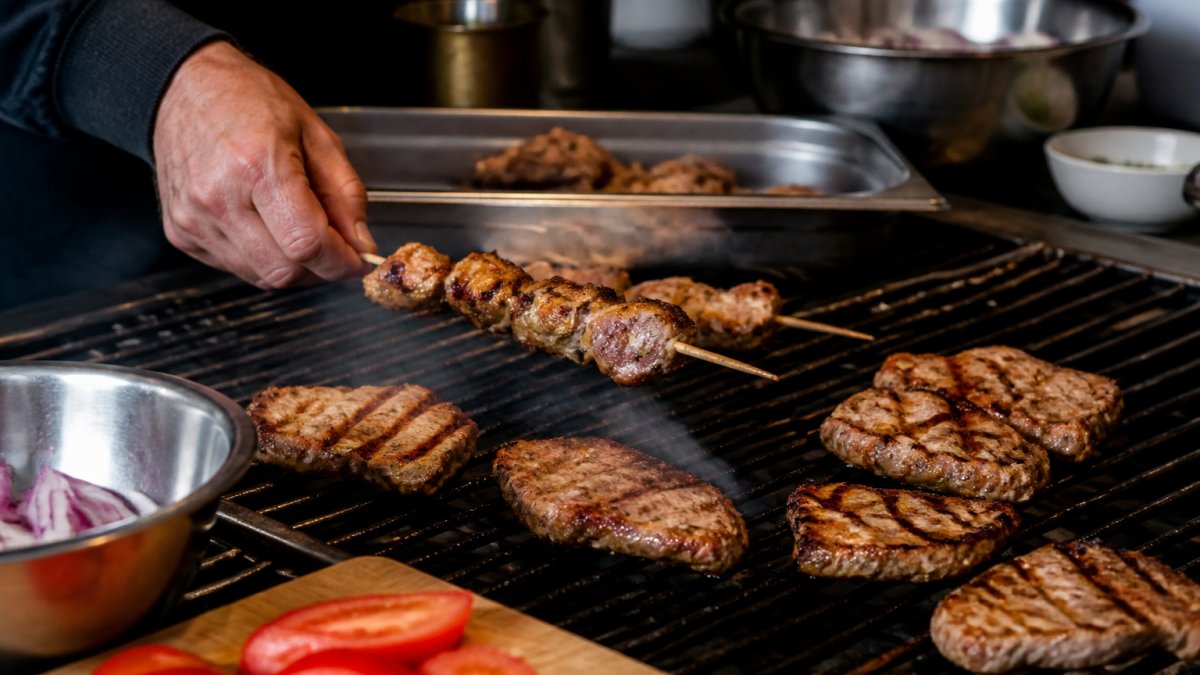
Greek beef souvlaki preparation comes down to a few clean steps. Follow them in order and you get tender, char-grilled cubes every time.
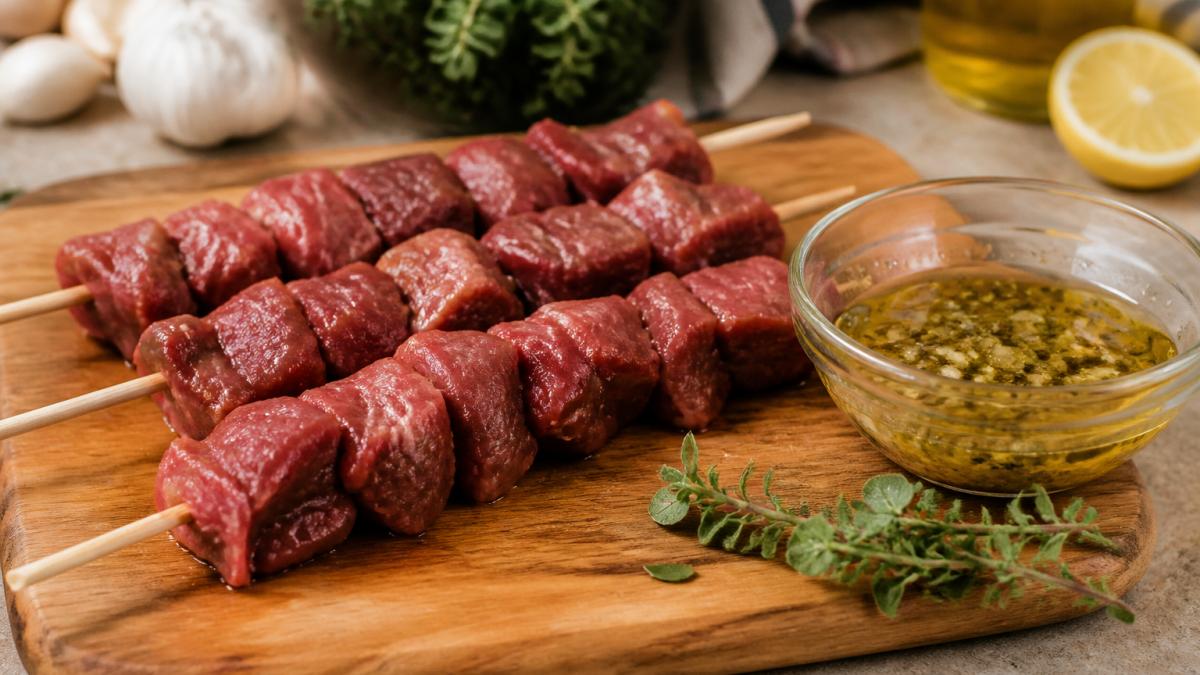
- Cut the beef into even 1-inch cubes so they cook at the same rate.
- Marinate for at least 2 hours using the recipe above.
- Soak wooden skewers in water for 30 minutes so they do not burn.
- Thread the cubes onto skewers, leaving a small gap between pieces for even cooking.
- Heat your grill to high, around 450 to 500°F for direct searing.
- Grill 3 to 4 minutes per side, turning once, until you get grill marks and the internal temperature hits 130 to 135°F for medium-rare.
- Rest the meat for 5 minutes before serving.
Serve with warm pita and tzatziki. Our guide on how to make authentic tzatziki at home gives you the classic sauce to go with it. For a related walkthrough, our recipe for traditional pork souvlaki covers the pork version step by step.
Here is the souvlaki process at a glance, from cutting the beef to resting the skewers.
| Step | What to do | Time or spec |
|---|---|---|
| Cut the beef | Cut into even 1-inch cubes | 1-inch cubes |
| Marinate | Use the steak marinade recipe | At least 2 hours |
| Soak skewers | Soak wooden skewers in water | 30 minutes |
| Thread | Thread cubes with a small gap between pieces | Small gap |
| Heat grill | Heat to high for direct searing | 450 to 500°F |
| Grill | Grill per side, turning once | 3 to 4 minutes per side |
| Internal temperature | Pull at medium-rare | 130 to 135°F |
| Rest | Rest the meat before serving | 5 minutes |
Grilling Techniques: Direct vs. Indirect Heat
Choosing between direct and indirect heat is the decision that separates good grilled meat from great grilled meat.
Direct heat means cooking right over the coals or burners. It is for searing, crust formation, and grill marks.
Indirect heat means cooking beside the heat source, with the lid down. It is for thicker cuts and bone-in pieces that need to cook through without burning.
The two-zone setup
The most useful skill in Greek grilling is building two zones on one grill. Light or pile your heat on one side, leave the other side empty, and you have a sear zone and a finish zone at the same time. Lamb chops, thick pork chops, and bone-in chicken all benefit from this: sear over direct heat until you have color, then move to the cool side, close the lid, and let the meat reach temperature slowly without scorching.
A simple rule we follow: sear first, finish second. Move the meat to the cool side once it has color, close the lid, and let it reach temperature slowly. For souvlaki and skewers, stay direct the whole way because the pieces are small and cook fast.
When to use which
- Direct only: beef and pork souvlaki cubes, chicken thigh skewers, thin steaks, shrimp, and anything under about 1 inch thick.
- Direct then indirect: lamb chops, thick pork chops, bone-in chicken, and whole cuts over 1.5 inches.
- Indirect only: large roasts and whole birds that need a long, gentle cook.
Temperature control at the grate
A grill thermometer clipped at grate level is more useful than the dial on the lid, because the lid gauge reads the air temperature, not the heat hitting the meat.
Watch out: opening the lid to check the meat drops the temperature inside the grill quickly, especially on gas. Check less often and use a quick-read thermometer instead of poking at the meat.
Indoor and oven conversion
Not everyone has an outdoor grill, and the same two-zone logic works indoors. A cast-iron grill pan over high heat handles the direct sear, and a 400°F oven handles the indirect finish. Sear the meat on the stovetop for 2 to 3 minutes per side, then move the pan to the oven until the internal temperature is where you want it.
Temperature control and a proper resting period solve most grilling problems. Resting lets the juices settle back into the meat instead of running out on the plate.
Wood Selection for Flavor Profiles
Most guides stop at charcoal versus gas. The wood you choose changes the flavor just as much, and this is where a lot of home cooks leave flavor on the table.
- Oak: strong, steady smoke that suits beef and lamb
- Apple or cherry: mild and slightly sweet, good for chicken and pork
- Hickory: bold and smoky, best in small amounts
For Greek grilling, we lean toward oak or a fruitwood. Greek cooking is about clean, bright flavors, and heavy smoke can bury the oregano and lemon. Soak wood chips for 30 minutes and add them to the coals just before the meat goes on.
Troubleshooting Common Greek Grilled Meat Mistakes
Even good cooks run into trouble. Here are the problems we see most, and how to fix them.
- Meat sticks to the grill: the grates were not hot or clean enough. Heat them well and oil them lightly.
- Dry, tough meat: the cut was too lean or it cooked too long. Use a thermometer and pull it early.
- No crust: the meat was wet when it hit the grill. Pat it dry first.
Watch out: never baste with a marinade that held raw meat unless you boil it first. Use a fresh batch for basting to keep things safe.
Temperature control and a proper resting period solve most of these problems. Resting lets the juices settle back into the meat instead of running out on the plate.
Frequently Asked Questions
What are the essential ingredients in a traditional Greek meat marinade?
A traditional Greek marinade relies on extra virgin olive oil, fresh lemon juice, garlic, and dried oregano. These four ingredients form the base for most Greek grilled meat recipes. Red wine vinegar is sometimes added for extra acidity, while Greek yogurt can be used in marinades for chicken or lamb to tenderize. The olive oil carries fat-soluble flavors, the lemon and vinegar break down protein fibers, and the oregano provides the signature Mediterranean aroma. Salt and black pepper are added to taste, but avoid over-salting since the marinade will reduce on the grill.
How long should you marinate meat for the best Greek flavor profile?
Marinating time depends on the meat and the marinade's acidity, so follow the guidance on the cut you are cooking. Always marinate in the refrigerator, never at room temperature, and pat the meat dry before grilling to encourage crust formation rather than steaming.
How does the Greek method of grilling differ from standard American BBQ?
Greek grilling commonly uses direct heat to create a charred exterior, and the seasoning is built on olive oil, lemon, and oregano.
What is the secret to keeping Greek grilled meats tender and juicy?
Two factors matter most: not overcooking and resting the meat. Use an instant-read thermometer to check doneness, and let the meat rest before slicing or serving so juices redistribute. Also, avoid piercing the meat with a fork during grilling; use tongs to turn skewers. A brief marinade with olive oil and lemon also helps, but acid should not dominate. Finally, choose cuts with some marbling, like lamb shoulder or beef sirloin, for natural tenderness.
Great grilled meat takes practice, but the payoff is a plate that tastes like a Greek taverna. At Gyro Kingdom, we do the work for you, grilling fresh gyros daily with chicken, lamb, beef, or pork and serving them with traditional Mediterranean sides. If you would rather skip the grill and enjoy the results, stop by for a meal, order delivery, or ask us about catering for your next gathering. Get started with Gyro Kingdom and taste authentic Greek food without leaving the Jersey Shore.